It’s All About Agency. Again.
Every eighty years or so, a society settles who gets to act. We are settling it again now, but this time there is a third hand on the scale.
History is usually told as a sequence of conflicts, economies, philosophies, inventions, rulers, and the like. But beneath all these is another, simpler pattern of the ebb and flow of agency. Societies forever renegotiate the same question: who holds the power to discern, define and direct events. What might appear as a relentless, albeit fragile, march toward greater human agency, is far more nuanced.
As civilization encounters bumps, turns, uphill climbs and downward slides, individuals and institutions inevitably collide. Sometimes agency shifts to the institution: the church, the crown, the state, the corporation. Then it shifts to the individual: rights, entitlements, preferences. Fortunately, the power never stays put for too long, because agency naturally concentrates, then disperses, then concentrates again.
The swing is not random. Nor is it mysterious. Societal forces act to move the balance to and fro, as gravity does to a pendulum.
Why write this now?
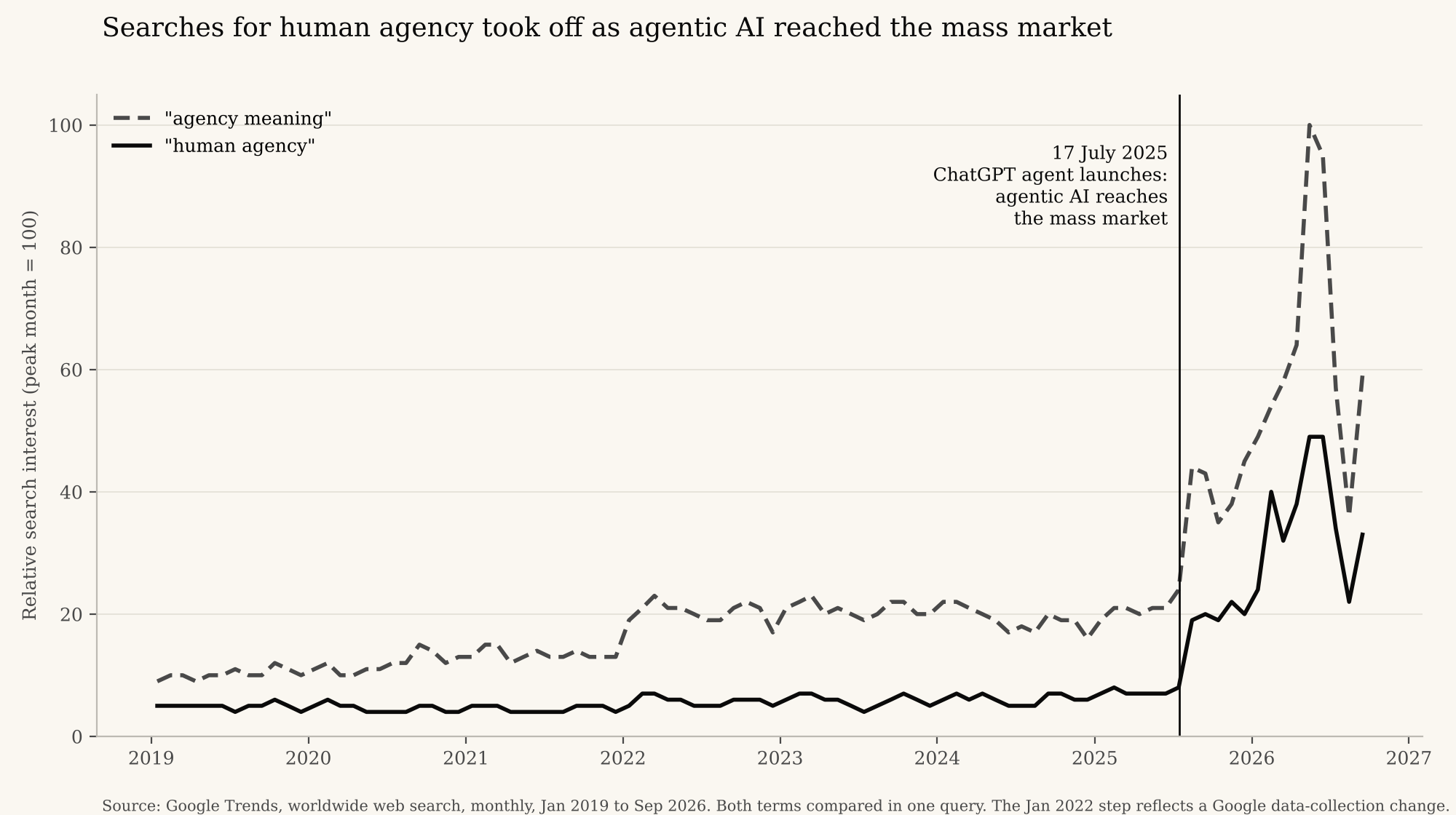
I have chosen to write about this now because the arrival of agentic AI for the masses has drawn the topic of agency to the epicenter of contemporary discourse, and its attraction is growing sharply. One bit of evidence is what people ask about. For five years, worldwide Google searches for “human agency” barely moved. Then in August 2025, the month after OpenAI put an agent inside ChatGPT for the mass market, they more than doubled. By 2026, they were running at about six times their 2024 level.
Given all this “Googling,” there should be no need to define agency here. But, for the sake of the argument, let’s define it as:
- the capacity to act; with
- the authority to make or carry out a decision; having
- accountability for the consequences.
The last point about accountability invites one of the great questions of the era: Can a machine be truly accountable? But we’ll have to reserve this for another Signal.
Agency is nothing new
Agency comes from the Latin agere, to act, and everyday language already divides it along the line this piece traces. On one side are institutions that act in a nation’s name: the Central Intelligence Agency, the National Security Agency, the Defense Intelligence Agency. On the other are people who act on someone else’s behalf: the travel agent who books the trip, the gate agent who decides who boards, the insurance agent who writes the policy, the customer service agent who can solve your problem or can’t. Each holds a slice of delegated agency, within limits someone else set. That last role is telling. Customer service was one of the first places agentic AI arrived at scale. Technology, in the form of knowledge bases and CRMs, enabled customer service agency more broadly so that the CSR could resolve customer needs and inquiries at huge scale. Today, the agent on the other end of the line is increasingly a bot, whose agency is still under negotiation. Throughout all this the meaning of the word never changed. What changed is who, or what, can hold agency.
A theoretical lens on what’s going on
In 1991, and more fully in 1997, William Strauss and Neil Howe described a rhythm in Anglo-American history they called the saeculum: a cycle of roughly eighty to one hundred years, about the length of a long human life. Each saeculum, they argue, passes through four “turnings” (hence the book’s title, The Fourth Turning) of about twenty to thirty years each: 1) High, 2) Awakening, 3) Unraveling and 4) Crisis.
Any theory of historical cycles, theirs included, faces criticisms, even contradictory evidence. Thus, all are best read as lenses rather than laws. But holding the four turnings thesis up to the question of agency brings ideas into sharper focus. Thus, Strauss and Howe’s four turnings thesis is a useful and corroborative map of where agency lives, and, more importantly, where it might be going.
The Four Turnings
The High turning follows a crisis. Institutions are strong and trusted, and individualism is weak. People have just come through something that required collective action to survive, so they hand agency to the structures that carried them through it. The American High, from 1946 to the mid-1960s, is the recent example. It produced the large corporation, the pension, the career ladder and a whole literature of conformity. William Whyte gave its archetype a name in 1956: the organization man. Agency sat at the center, and most people were content to leave it there.
Next comes the Awakening turning. The institutions are still standing, but a generation raised inside them begins to ask what they cost. Agency is reclaimed in the name of the individual, the conscience, the inner life. The Consciousness Revolution of the late 1960s and 1970s is the recent case. Five centuries earlier, the Protestant Reformation made the same move at larger scale: a person reading scripture for himself, against an institution that had held the sole right to interpret it for a thousand years.
An Unraveling follows. During this third turning individualism is strong, and institutions are weak and distrusted. Agency has dispersed so far that the shared structures begin to fray. From the mid-1980s to 2008, the defining words were free agency, shareholder value and self-reliance. Institutions did not disappear. They shed their obligations and handed the risk to the person.
Then comes the fourth turning, Crisis. Here, the old order breaks under a shock it can no longer absorb, and a society rebuilds its institutions, quickly and under duress. Agency recentralizes, because collective problems demand collective action. The last Crisis ran from the crash of 1929 to the end of the Second World War, and it built the institutions the next High would live inside for a generation. In The Fourth Turning Is Here, published in 2023, Howe dates the current Crisis from the financial collapse of 2008 and expects it to resolve in the early 2030s.
Then the see-saw cycle starts all over again.
Technology drives, and is driven by, the cycle
Here is the part of the pattern that matters most right now. Every great technology of agency arrives with a bias, and the turning it lands in decides how that bias plays out.
The printing press is remembered as a decentralizing force, and it was, in part because of when it matured. Luther posted his theses in 1517, at the opening of an Awakening. Within weeks his argument was in print across Germany. A generation that already wanted to reclaim agency from the church found a machine that let it. Seventy years later, in the ensuing Crisis, the English crown used the same machine the opposite way. A Star Chamber decree in 1586 restricted who could own a press and put printing under license. Same technology. Different turning. Opposite result. Here’s an interesting historical anecdote: At this time in history, copyright laws were not the least bit concerned with authorship, only printership. The law protected who owned the right to print, not who owned the words being printed. Oh, how times change.
The pattern repeats closer to home. The mainframe centralized computing during the most recent American High turn, inside the corporation and under its control. The personal computer arrived at the tail of the Awakening, and the internet spread through the Unraveling, and both dispersed it. Each felt like destiny at the time. Each was also riding a predictable swing already in motion.
AI is the most capable technology of agency yet built, and it has arrived in a Crisis turn.
That timing should concern anyone who designs organizations. A Crisis is the turning in which, historically, agency recentralizes. AI is extraordinarily good at centralizing agency. A system that can interpret, decide and act at scale can be placed at the center and asked to do what thousands of distributed people once did.
Meanwhile, the fragmentation of social values and the erosion of institutional legitimacy are, as we speak, pulling at us to recentralize agency. Strauss and Howe gave that pull a human face. They called it the Gray Champion, after Nathaniel Hawthorne’s story of the same name: an elder old enough to have lived through every prior turning, who leads society back toward the values of the last High. They cite historical Gray Champions in Abraham Lincoln and Franklin D. Roosevelt.
The pull of the turning and the bias of the technology point the same way. That alignment is what makes this Crisis different from the last one.
The new three-way tug of war
Every previous swing was a contest between two parties. Inside an organization, that meant human agency on one end of the rope and organizational agency on the other. The pendulum moved between them, and each turning settled, at least for a while, how much agency each side held.
This Crisis adds a third party. AI systems can now interpret, decide and act, and that capacity is a form of agency in its own right. It belongs to neither the person nor the organization, although both will try to claim it. So when an organization recentralizes this time, it faces a choice the 1940s did not offer. It can recentralize into people, structures and governance, as every previous Crisis did. Or it can recentralize into the machine, and let human and organizational judgment thin out behind it.
Handing judgment to the machine rarely feels like a decision. It happens one convenience at a time. The system, not a person, drafts the answer. It flags the risk, so no one has to look for it. It approves the routine request, so no one asks whether it still makes sense. Each step saves a little effort, and each one seems too small to matter. No one is forced to give anything up. People simply stop using judgment until they lose the habit, then the skill, and finally the authority to use it. A later generation that wants it back will have a completely different historical challenge.
Where the rope is pulled hardest
This tug of war is not abstract. It runs straight through the corporate functions: Human Resources, Finance, IT, Procurement, Legal and the shared services that deliver them. These are the places where an organization writes down who may act, on what, and with whose authority.
They are also artifacts of the pendulum. The personnel department, central finance and the data processing department were built in the last High to administer the organization man. In the Unraveling, the same functions changed shape. Pensions became individual accounts. Careers became the employee’s own project. Self-service portals moved administration onto the person. At the same time, transactional work was pulled into shared services, consolidated, standardized and run at a distance. The institution kept the transaction and let go of the person. That is the Unraveling in miniature: organizational obligation shrinking while organizational control of process grew.
Now the Crisis reaches these functions, and it arrives carrying AI. The transactional work the Unraveling centralized is exactly the work AI is best at absorbing. The path of least resistance is plain. Put agentic systems at the center of the shared services model, let them run the process, and treat the people who remain as handlers of exceptions. It will look efficient. It will look like order restored. But if we are not mindful, it will simply be the next Crisis recentralizing agency in the machine.
The other path is harder and more durable. It treats this moment as what a Crisis has always been: a short window in which the structures for the next generation are set. It asks each corporate function to rebuild organizational agency on purpose, with AI inside it, and to design human agency to expand alongside the machine rather than contract behind it. Decision rights, information flows, incentives, governance and boundaries are where that settlement is made, one function at a time.
And the settlement will outlast the people who make it. The functions built in the 1940s ran on largely the same assumptions for half a century. The ones built over the next several years will set the terms of work for the High that follows.
Again…
I have attempted to argue that every societal turning over nearly six centuries of the pattern Strauss and Howe traced has been a renegotiation of agency. The Reformation was about agency. The Revolution was about agency. The New Deal was about agency. And, so were the rise of the free agent and the demise of the pension.
But there is a new question. Every previous Crisis asked how much agency the institution should hold and how much the individual should keep. This one asks that same question, plus others no earlier Crisis has: where should the new holder of agency sit, and does it replace or amplify the others?
History suggests the answer will be settled by the early 2030s, whether anyone designs it or not.
One way or another, the pendulum will swing.